



















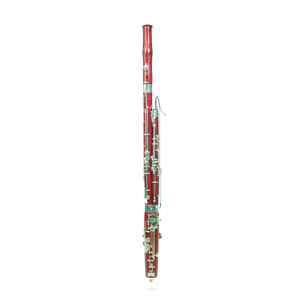
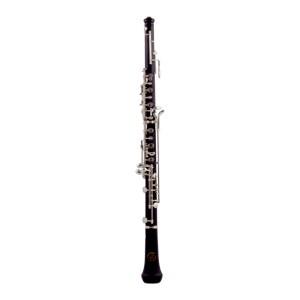


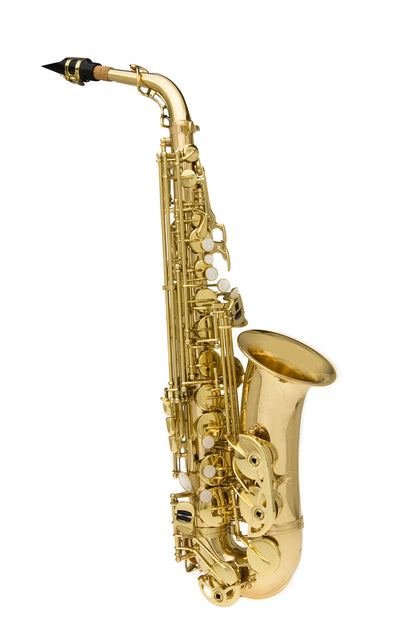
JP 181 Oboe C Silver Plated Keys This oboe has a very high specification (dual system) and will see the player from novice through to the higher grades. It has excellent performance characteristics at an accessible price. Recommended by Max Spiers - Royal Ballet Sinfonia This is the latest assessment of the new improved JP181 oboe
Never ones to rest on laurels, John Packers have recently furthered their JP 181 project to bring the oboe to young, (or even not-so-
young) beginners at a fraction of the cost to what would normally be associated with prohibitively expensive orchestral instruments. I
reviewed the first example very favourably with just a few misgivings. Those now seem to have been tidied up and ironed out -
the new JP 181 is greatly improved.
The padding is now much more akin to that of an intermediate instrument with white leather pads on the low notes. These will
give a better seal, are less noisy and will cause less trouble over time. The cork pads are thinner and less spongy and keywork has
been vastly improved. The mechanism is now much neater and stronger with sensibly placed adjusting screws that don't require a
screwdriver with the width of a leprechaun's finger nail and the leverage of a pickax to adjust, as some other makers of student
instruments do... The 181 also seem to be up to pitch now where previously they were a little low.
Still the triumph of these instruments is that they really ring. The natural sound of them encourages a warm tone and the scale is
even and smooth. They slur all the awkward intervals effortlessly and feel nicely stable.
More innovations can be found in a pre-JP 181 form with a brand new instrument specifically designed as an introduction to the oboe for
the first few terms of study. The JP 081 is very light-weight and I'm told will incorporate that all-important adjustable thumb rest,
so essential for little fingers and hands. Keywork is the absolute minimum but will facilitate progress up to about grade III level.
Designed with the local music education service in mind, these are retailing for half the price of the JP 181 and so can offer a two-
for-one option to authorities for introducing the oboe to young people. Acoustically, they blow almost identically to the JP 181
and in fact, one very respected teacher who tried the example I had to review, thought it made a slightly better sound!
Exciting innovations then at the cutting edge of modern instrument manufacturing technology from John Packers. It is so refreshing to
find a company who are really willing to listen to the professional players and then act upon their advice, and the improved results
should keep this line at the forefront of instruments of this price range - surely the first choice for students and educational
authorities alike.
Maxwell Spiers B. Mus Hons (RCM) - Royal Ballet Sinfonia
This is the original critique…..
The JP 181 oboe from John Packer Woodwind Ltd.
In the relatively recent wake of government reports that deem the oboe an “unpopular” instrument, with declining take up in schools relegating it to Tessa Jowell’s list of endangered instruments, John Packer Woodwind Ltd. unveil their new student oboe retailing at under £600. Max Spiers was asked to take a closer look.
I was recently asked to try a new comer to the world of oboe manufacture by John Packer Woodwind, in Taunton. This is an oboe designed by those in the know at John Packer, in conjunction with an instrument manufacturer in China. Before the mention of the words “China” and “Oboe Manufacture” in the same sentence puts you off, please read on – you might be as surprised as I was…
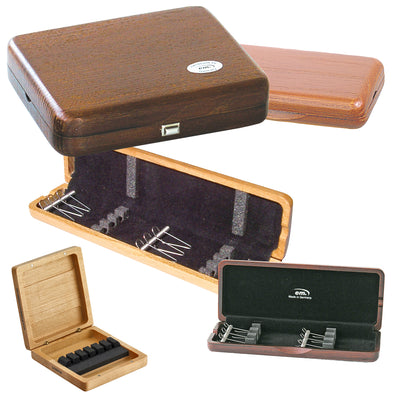
The new JP181 oboe is beautifully presented in a superb case, worthy of a professional instrument and far better than some that are supplied with the very highest priced instruments. The case cover is unfortunately a little too close fitting and can catch on the case itself when trying to close, but otherwise the pocket is a good size and the presentation is really very smart indeed.
The instrument itself perhaps will not take too much aesthetic scrutiny, but what it lacks in refinement on the outside, it certainly makes up for in the way it plays. I am unclear as to whether this oboe is made from a resin or a resin/wood composite. Whatever it is, it really vibrates very well and you can feel the instrument ringing – something that other resin instruments that I have tried have fallen down on. In general, the example that I had to try was quite low in pitch, although perhaps my reed set-up is longer than some.
Even in its slightly “baroque” state, it was obviously an instrument that had a lot going for it. The top register sings beautifully without too much pushing on those very weak high C’s and B’s. All the very top notes seem to be there and without the third octave key too, which has been dispensed with, presumably for cost purposes. I even managed to pop out a top ‘A’ fairly innocuously! The middle register is even with good intonation and the low register was dark and warm, although it seemed to take a few minutes of blowing to let the pads settle before it became really comfortable.
A word about the pads, which are all very thick indeed; I expressed my concerns about these to John Packers and I hope that they might re-think them with a modification. Cork pads are wonderful for getting an instrument really airtight, but when they are as thick as these, there is so much more room for error should they shift, warp, split, swell or shrink, and this could lead to an instrument becoming unreliable. As it is, the JP181 blows incredibly well but I wondered how long it would be before the pads started shifting and caused problems.
Slurring intervals doesn’t pose any problems at all for this oboe. Even the notorious D-G slur down that so many instruments that are made these days simply can’t do, the JP181 managed reliably and there was a healthy feeling of stability here.
The key work is pretty solid and responsive with silver plating, and the addition of an adjustable thumb rest is very welcome. I feel this is essential at every stage of playing the oboe, but particularly with young players whose hands and arms are growing. It is so important to get the placement of the thumb right from the start. Clearly, it will be the young players’ market where I think the JP181 oboes will excel. With a long F and a Gillet top joint with all the trills, this is a very high specification oboe at the student price range, and we should not underestimate the potential impact of these instruments on the up and coming generation of students who will make the future of oboe playing in this country.
And, of course, the price is the real trump card in John Packer’s hand. At £599, I genuinely believe that this is a real breakthrough in oboe manufacture. To be able to produce something that blows as well as this; something that can make a very beautiful sound and yet does it all for that sort of price tag, is a remarkable achievement. John Packer Woodwind Ltd. have furthered the cause of getting young people to learn to play the oboe which should do much to turn around the concept of English Oboe Playing being an endangered occupation.
I always think of an instrument as being a tool for talent. Obviously, the perfect oboe has never been made, but if an instrument is able to be a vehicle through which a player’s talents can shine, then surely it has done its job and the aims of the craftsman manufacturing that instrument have been fully realized. I know that the oboe I did my audition on for the Royal College of Music didn’t blow nearly as well as this instrument, and perhaps wistfully reminisced what might have been had the JP 181 been my first experience of playing.
In short then, I really cannot recommend this oboe highly enough. At last, modern manufacturing techniques have made available an instrument of superb playing quality at an unbelievable price, and I hope that this will entice oboe playing out of it’s current exclusive and prohibitively expensive corner of the market, guaranteeing youngsters and amateurs alike the chance to grapple with, experiment and love that idiosyncratic enigma of instruments.
Maxwell Spiers - Royal Ballet Sinfonia.